another language

English French German Spain Italian Dutch

Russian Portuguese Japanese Korean Arabic Chinese Simplified
by : BTF

My Job With Photoshop CS3

SKIN IN STONE . HAHAHAHA

CRAZY COUPLE ANYMORE

i love him and he loved me too

go to taman ujung bali

best view in bali . enjoy it

HEY , SHE IS SO BEAUTIFULL

that's me , LoL

This is default featured post 5 title

Go to Blogger edit html and find these sentences.Now replace these sentences with your own descriptions.This theme is Bloggerized by Lasantha Bandara - Premiumbloggertemplates.com.

Showing posts with label biography of physicist. Show all posts

Sunday, 3 April 2011

MAX PLANCK


Max PlanckMax Karl Ernst Ludwig Planck was born in Kiel, Germany, on April 23, 1858, the son of Julius Wilhelm and Emma (néePatzig) Planck. His father was Professor of Constitutional Law in the University of Kiel, and later in Göttingen.
Planck studied at the Universities of Munich and Berlin, where his teachers included Kirchhoff and Helmholtz, and received his doctorate of philosophy at Munich in 1879. He was Privatdozent in Munich from 1880 to 1885, then Associate Professor of Theoretical Physics at Kiel until 1889, in which year he succeeded Kirchhoff as Professor at Berlin University, where he remained until his retirement in 1926. Afterwards he became President of the Kaiser Wilhelm Society for the Promotion of Science, a post he held until 1937. The Prussian Academy of Sciences appointed him a member in 1894 and Permanent Secretary in 1912.
Planck's earliest work was on the subject of thermodynamics, an interest he acquired from his studies under Kirchhoff, whom he greatly admired, and very considerably from reading R. Clausius' publications. He published papers on entropy, on thermoelectric ity and on the theory of dilute solutions.
At the same time also the problems of radiation processes engaged his attention and he showed that these were to be considered as electromagnetic in nature. From these studies he was led to the problem of the distribution of energy in the spectrum of full radiation. Experimental observations on the wavelength distribution of the energy emitted by a black body as a function of temperature were at variance with the predictions of classical physics. Planck was able to deduce the relationship between the ener gy and the frequency of radiation. In a paper published in 1900, he announced his derivation of the relationship: this was based on the revolutionary idea that the energy emitted by a resonator could only take on discrete values or quanta. The energy for a resonator of frequency v is hv where h is a universal constant, now called Planck's constant.
This was not only Planck's most important work but also marked a turning point in the history of physics. The importance of the discovery, with its far-reaching effect on classical physics, was not appreciated at first. However the evidence for its validi ty gradually became overwhelming as its application accounted for many discrepancies between observed phenomena and classical theory. Among these applications and developments may be mentioned Einstein's explanation of the photoelectric effect.
Planck's work on the quantum theory, as it came to be known, was published in the Annalen der Physik. His work is summarized in two books Thermodynamik (Thermodynamics) (1897) and Theorie der Wärmestrahlung (Theory of heat radiat ion) (1906).
He was elected to Foreign Membership of the Royal Society in 1926, being awarded the Society's Copley Medal in 1928.
Planck faced a troubled and tragic period in his life during the period of the Nazi government in Germany, when he felt it his duty to remain in his country but was openly opposed to some of the Government's policies, particularly as regards the persecuti on of the Jews. In the last weeks of the war he suffered great hardship after his home was destroyed by bombing.
He was revered by his colleagues not only for the importance of his discoveries but for his great personal qualities. He was also a gifted pianist and is said to have at one time considered music as a career.
Planck was twice married. Upon his appointment, in 1885, to Associate Professor in his native town Kiel he married a friend of his childhood, Marie Merck, who died in 1909. He remarried her cousin Marga von Hösslin. Three of his children died young, leaving him with two sons.
He suffered a personal tragedy when one of them was executed for his part in an unsuccessful attempt to assassinate Hitler in 1944.
He died at Göttingen on October 4, 1947.

Tuesday, 29 March 2011

Daniel Bernoulli


1700-1782
Daniel Bernoulli was the son of Johann Bernoulli, a mathematician, and his brother Nicolaus and his uncle Jacob were also mathematicians. Daniel was sent to Basel University at the age of 13 to study philosophy and logic. Daniel really wanted to study mathematics, and during his time there he was learning calculus from his father and his older brother. His father insisted he take up a trade and sent Daniel back to Basel University to study medicine. Daniel completed his doctorate in medicine in 1720, writing his doctoral dissertation on the mechanics of breathing.
Failing to obtain an academic post, Daniel went to Venice to study practical medicine. There he worked on mathematics, and with Goldbach's assistance, published his first mathematical workMathematical Exercises, in 4 parts. The first part described faro, a game of chance. The second part was on the flow of water from a hole in a container. The third part was on the Riccati differential equation, while the final part was on a geometry question concerning figures bounded by two arcs of a circle. Daniel attained fame due to Mathematical Exercises, and consequently he and his brother were offered mathematics positions in St. Petersburg in 1725.
Soon after they arrived, his brother Nicolaus died of fever. To cheer him up, Johann Bernoulli sent one of his pupils, Leonard Euler, to St. Petersburg to work with Daniel in 1727. This time was very productive for the both of them. He studied vibrating systems, showing that the movements of strings of musical instruments are composed of an infinite number of harmonic vibrations all superimposed on the string. He also produced an important work on probability and political economy.
 Undoubtedly the most important work which Daniel Bernoulli did while in St Petersburg was his work on hydrodynamics, a term he invented. This work contains for the first time the correct analysis of water flowing from a hole in a container. This was based on the principle of conservation of energy which he had studied with his father in 1720. Daniel also discussed pumps and other machines to raise water. He also discussed the basis for the kinetic theory of gases. He was able to give the basic laws for the theory of gases and gave the equation of state discovered by Van der Waals a century later.
Daniel returned to Europe and lectured on botany from 1733 to 1743. In 1734, Daniel Bernoulli submitted an entry for the Grand Prize of the Paris Academy giving an application of his ideas to astronomy. He and his father were declared joint winners of the Grand Prize. As a result, his father was furious to think that his son was considered his equal, and banned him from his house.
Meanwhile, Daniel and Euler continued to correspond. Euler used his great analytic skills to put many of Daniel's physical insights into a rigorous mathematical form. Daniel continued to work on his hydrodynamics book, and it was published in 1738. In 1743, he began lecturing on physiology. In 1750, he was appointed to the chair of physics and taught physics at Basel for 26 years until 1776. He gave some remarkable physics lectures with experiments performed during the lectures. Based on experimental evidence he was able to conjecture certain laws which were not verified until many years later. Among these was Coulomb's law in electrostatics.
Daniel Bernoulli did produce other excellent scientific work during these many years back in Basel. In total he won the Grand Prize of the Paris Academy 10 times, for topics in astronomy and nautical topics. He won in 1737 for work on the best shape for a ships's anchor; 1740 (jointly with Euler) for work on Newton's theory of the tides; in 1743 and 1746 for essays on magnetism; in 1747 for a method to determine time at sea; in 1751 for an essay on ocean currents; in 1753 for the effects of forces on ships; and in 1757 for proposals to reduce the pitching and tossing of a ship in high seas.
Another important aspect of Daniel Bernoulli's work that proved important in the development of mathematical physics was his acceptance of many of Newton's theories. Daniel worked on mechanics and used the principle of conservation of energy which gave an integral of Newton's basic equations. He also studied the movement of bodies in a resisting medium using Newton's methods. He also continued to produce good work on the theory of oscillations and in a paper he gave a beautiful account of the oscillation of air in organ pipes.
Daniel Bernoulli was much honoured in his own lifetime. He was elected to most of he leading scientific societies of his day including those in Bologna, St. Petersburg, Berlin, Paris, London, Bern, Turin, Zurich and Mannheim.

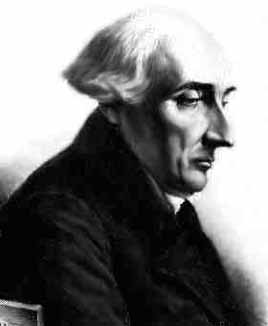
Joseph-Louis Lagrange


Joseph-Louis Lagrange is usually considered to be a French mathematician, but the Italian Encyclopaedia [40] refers to him as an Italian mathematician. They certainly have some justification in this claim since Lagrange was born in Turin and baptised in the name of Giuseppe Lodovico Lagrangia. Lagrange's father was Giuseppe Francesco Lodovico Lagrangia who was Treasurer of the Office of Public Works and Fortifications in Turin, while his mother Teresa Grosso was the only daughter of a medical doctor from Cambiano near Turin. Lagrange was the eldest of their 11 children but one of only two to live to adulthood.
Turin had been the capital of the duchy of Savoy, but became the capital of the kingdom of Sardinia in 1720, sixteen years before Lagrange's birth. Lagrange's family had French connections on his father's side, his great-grandfather being a French cavalry captain who left France to work for the Duke of Savoy. Lagrange always leant towards his French ancestry, for as a youth he would sign himself Lodovico LaGrange or Luigi Lagrange, using the French form of his family name.
Despite the fact that Lagrange's father held a position of some importance in the service of the king of Sardinia, the family were not wealthy since Lagrange's father had lost large sums of money in unsuccessful financial speculation. A career as a lawyer was planned out for Lagrange by his father, and certainly Lagrange seems to have accepted this willingly. He studied at the College of Turin and his favourite subject was classical Latin. At first he had no great enthusiasm for mathematics, finding Greek geometry rather dull.
Lagrange's interest in mathematics began when he read a copy of Halley's 1693 work on the use of algebra in optics. He was also attracted to physics by the excellent teaching of Beccaria at the College of Turin and he decided to make a career for himself in mathematics. Perhaps the world of mathematics has to thank Lagrange's father for his unsound financial speculation, for Lagrange later claimed:-
If I had been rich, I probably would not have devoted myself to mathematics.
He certainly did devote himself to mathematics, but largely he was self taught and did not have the benefit of studying with leading mathematicians. On 23 July 1754 he published his first mathematical work which took the form of a letter written in Italian to Giulio Fagnano. Perhaps most surprising was the name under which Lagrange wrote this paper, namely Luigi De la Grange Tournier. This work was no masterpiece and showed to some extent the fact that Lagrange was working alone without the advice of a mathematical supervisor. The paper draws an analogy between the binomial theorem and the successive derivatives of the product of functions.
Before writing the paper in Italian for publication, Lagrange had sent the results to Euler, who at this time was working in Berlin, in a letter written in Latin. The month after the paper was published, however, Lagrange found that the results appeared in correspondence between Johann Bernoulli and Leibniz. Lagrange was greatly upset by this discovery since he feared being branded a cheat who copied the results of others. However this less than outstanding beginning did nothing more than make Lagrange redouble his efforts to produce results of real merit in mathematics. He began working on the tautochrone, the curve on which a weighted particle will always arrive at a fixed point in the same time independent of its initial position. By the end of 1754 he had made some important discoveries on the tautochrone which would contribute substantially to the new subject of the calculus of variations (which mathematicians were beginning to study but which did not receive the name 'calculus of variations' before Euler called it that in 1766).
Lagrange sent Euler his results on the tautochrone containing his method of maxima and minima. His letter was written on 12 August 1755 and Euler replied on 6 September saying how impressed he was with Lagrange's new ideas. Although he was still only 19 years old, Lagrange was appointed professor of mathematics at the Royal Artillery School in Turin on 28 September 1755. It was well deserved for the young man had already shown the world of mathematics the originality of his thinking and the depth of his great talents.
In 1756 Lagrange sent Euler results that he had obtained on applying the calculus of variations to mechanics. These results generalised results which Euler had himself obtained and Euler consulted Maupertuis, the president of the Berlin Academy, about this remarkable young mathematician. Not only was Lagrange an outstanding mathematician but he was also a strong advocate for the principle of least action soMaupertuis had no hesitation but to try to entice Lagrange to a position in Prussia. He arranged with Euler that he would let Lagrange know that the new position would be considerably more prestigious than the one he held in Turin. However, Lagrange did not seek greatness, he only wanted to be able to devote his time to mathematics, and so he shyly but politely refused the position.
Euler also proposed Lagrange for election to the Berlin Academy and he was duly elected on 2 September 1756. The following year Lagrange was a founding member of a scientific society in Turin, which was to become the Royal Academy of Sciences of Turin. One of the major roles of this new Society was to publish a scientific journal the Mélanges de Turin which published articles in French or Latin. Lagrange was a major contributor to the first volumes of the Mélanges de Turin volume 1 of which appeared in 1759, volume 2 in 1762 and volume 3 in 1766.
The papers by Lagrange which appear in these transactions cover a variety of topics. He published his beautiful results on the calculus of variations, and a short work on the calculus of probabilities. In a work on the foundations of dynamics, Lagrange based his development on the principle of least action and on kinetic energy.
In the Mélanges de Turin Lagrange also made a major study on the propagation of sound, making important contributions to the theory of vibrating strings. He had read extensively on this topic and he clearly had thought deeply on the works of NewtonDaniel BernoulliTaylorEuler and d'Alembert. Lagrange used a discrete mass model for his vibrating string, which he took to consist of n masses joined by weightless strings. He solved the resulting system of n+1 differential equations, then let n tend to infinity to obtain the same functional solution as Euler had done. His different route to the solution, however, shows that he was looking for different methods than those of Euler, for whom Lagrange had the greatest respect.
In papers which were published in the third volume, Lagrange studied the integration of differential equations and made various applications to topics such as fluid mechanics (where he introduced the Lagrangian function). Also contained are methods to solve systems of linear differential equations which used the characteristic value of a linear substitution for the first time. Another problem to which he applied his methods was the study the orbits of Jupiter and Saturn.
The Académie des Sciences in Paris announced its prize competition for 1764 in 1762. The topic was on the libration of the Moon, that is the motion of the Moon which causes the face that it presents to the Earth to oscillate causing small changes in the position of the lunar features. Lagrange entered the competition, sending his entry to Paris in 1763 which arrived there not long before Lagrange himself. In November of that year he left Turin to make his first long journey, accompanying the Marquis Caraccioli, an ambassador from Naples who was moving from a post in Turin to one in London. Lagrange arrived in Paris shortly after his entry had been received but took ill while there and did not proceed to London with the ambassador. D'Alembert was upset that a mathematician as fine as Lagrange did not receive more honour. He wrote on his behalf [1]:-

SIR ISSAC NEWTON


Isaac Newton was born on December 25, 1642 (by the Julian calendar then in use; or January 4, 1643 by the current Gregorian calendar) in Woolsthorpe, near Grantham in Lincolnshire, England. He was born the same year Galileo died. Newton is clearly the most influential scientist who ever lived. His accomplishments in mathematics, optics, and physics laid the foundations for modern science and revolutionized the world.

Newton was educated at Trinity College, Cambridge where he lived from 1661 to 1696. During this period he produced the bulk of his work on mathematics. In 1696 he was appointed Master of the Royal Mint, and moved to London, where he resided until his death.

As mathematician, Newton invented integral calculus, and jointly with Leibnitz, differential calculus. He also calculated a formula for finding the velocity of sound in a gas which was later corrected by Laplace.

Newton made a huge impact on theoretical astronomy. He defined the laws of motion anduniversal gravitation which he used to predict precisely the motions of stars, and the planets around the sun. Using his discoveries in optics Newton constructed the first reflecting telescope.

Newton found science a hodgepodge of isolated facts and laws, capable of describing some phenomena, but predicting only a few. He left it with a unified system of laws that can be applied to an enormous range of physical phenomena, and that can be used to make exact predications. Newton published his works in two books, namely "Opticks" and "Principia."

Newton died in London on March 20, 1727 and was buried in Westminster Abbey, the first scientist to be accorded this honor. A review of an encyclopedia of science will reveal at least two to three times more references to Newton than any other individual scientist. An 18th century poem written by Alexander Pope about Sir Isaac Newton states it best:

JAMES WATT

James Watt (1736-1819)


source: Helmut Hütten, "Motoren", Motorbuchverlag Stuttgart, Cover
A Scottish instrument maker, mechanical engineer and inventor, who contributed to the Industrial Revolution with his improvements of the steam engine.

James Watt was born on January 19, 1736, in Greenock, Scotland. At the age of 17, while becoming intrigued with Thomas Newcomen's steam engine, he decided to become a maker of mathematical instruments. Two years later, he became interested in improving the Newcomen-Savery steam engines that were used to pump water from mines at the time.

By the age of 29, Watt created a separated condenser for steam engines. He determined the properties of steam, especially the relation of its density to its pressure and temperature. Having this in mind, he designed a separate condensing chamber for the steam engine, which seized great losses of steam in the cylinder and improved the vacuum conditions. In 1767, he built an attachment that made telescopes suitable for the measurement of distances. In 1768, he associated with John Roebuck of the Carron, a British inventor who had financed Watt's researches, and received a patent the next year for his method of lessening the consumption of fuel and steam in an engine and for other enhancements on Newcomen's device.

In 1772, John Roebuck became bankrupt and, three years later, Matthew Boulton, a British manufacturer who owned the Soho Engineering Works at Birmingham, became Watt's new associate. Watt and Boulton began the manufacture of steam engines.

James W. supervised the installation of pumping engines in copper and tin mines from 1776 to 1781. His study on engines continued and he received many patents for other important inventions, which included the sun-and-planet gear, the rotary engine, the double-action engine, and the steam indicator.

In 1785, he was chosen as a fellow of the Royal Society of London.

In 1788, he invented the centrifugal or flyball governor that regulated the speed of an engine automatically and, in 1790, the pressure gauge. In the XIX century, he retired from the firm and dedicated himself to his research work. 

James Watt was sometimes mistaken by the actual creator of the steam engine. This was due to the great contributions he has done on the development of this device.

The Watt, the electrical unit (or unit of Power), was named in his honor.

Besides being an inventor and a mechanical engineer, Watt was also a civil engineer and made various surveys of canal routes.

He died on August 19, 1819, in Heathfield, England. 


Copy from http://library.thinkquest.org

ALBERT EINSTEIN

Biography

Albert EinsteinAlbert Einstein was born at Ulm, in Württemberg, Germany, on March 14, 1879. Six weeks later the family moved to Munich, where he later on began his schooling at the Luitpold Gymnasium. Later, they moved to Italy and Albert continued his education at Aarau, Switzerland and in 1896 he entered the Swiss Federal Polytechnic School in Zurich to be trained as a teacher in physics and mathematics. In 1901, the year he gained his diploma, he acquired Swiss citizenship and, as he was unable to find a teaching post, he accepted a position as technical assistant in the Swiss Patent Office. In 1905 he obtained his doctor's degree.

During his stay at the Patent Office, and in his spare time, he produced much of his remarkable work and in 1908 he was appointed Privatdozent in Berne. In 1909 he became Professor Extraordinary at Zurich, in 1911 Professor of Theoretical Physics at Prague, returning to Zurich in the following year to fill a similar post. In 1914 he was appointed Director of the Kaiser Wilhelm Physical Institute and Professor in the University of Berlin. He became a German citizen in 1914 and remained in Berlin until 1933 when he renounced his citizenship for political reasons and emigrated to America to take the position of Professor of Theoretical Physics at Princeton*. He became a United States citizen in 1940 and retired from his post in 1945.

After World War II, Einstein was a leading figure in the World Government Movement, he was offered the Presidency of the State of Israel, which he declined, and he collaborated with Dr. Chaim Weizmann in establishing the Hebrew University of Jerusalem.

Einstein always appeared to have a clear view of the problems of physics and the determination to solve them. He had a strategy of his own and was able to visualize the main stages on the way to his goal. He regarded his major achievements as mere stepping-stones for the next advance.

At the start of his scientific work, Einstein realized the inadequacies of Newtonian mechanics and his special theory of relativity stemmed from an attempt to reconcile the laws of mechanics with the laws of the electromagnetic field. He dealt with classical problems of statistical mechanics and problems in which they were merged with quantum theory: this led to an explanation of the Brownian movement of molecules. He investigated the thermal properties of light with a low radiation density and his observations laid the foundation of the photon theory of light.

In his early days in Berlin, Einstein postulated that the correct interpretation of the special theory of relativity must also furnish a theory of gravitation and in 1916 he published his paper on the general theory of relativity. During this time he also contributed to the problems of the theory of radiation and statistical mechanics.

In the 1920's, Einstein embarked on the construction of unified field theories, although he continued to work on the probabilistic interpretation of quantum theory, and he persevered with this work in America. He contributed to statistical mechanics by his development of the quantum theory of a monatomic gas and he has also accomplished valuable work in connection with atomic transition probabilities and relativistic cosmology.

After his retirement he continued to work towards the unification of the basic concepts of physics, taking the opposite approach, geometrisation, to the majority of physicists.

Einstein's researches are, of course, well chronicled and his more important works includeSpecial Theory of Relativity (1905), Relativity (English translations, 1920 and 1950), General Theory of Relativity (1916), Investigations on Theory of Brownian Movement (1926), and The Evolution of Physics (1938). Among his non-scientific works, About Zionism (1930), Why War?(1933), My Philosophy (1934), and Out of My Later Years (1950) are perhaps the most important.

Albert Einstein received honorary doctorate degrees in science, medicine and philosophy from many European and American universities. During the 1920's he lectured in Europe, America and the Far East and he was awarded Fellowships or Memberships of all the leading scientific academies throughout the world. He gained numerous awards in recognition of his work, including the Copley Medal of the Royal Society of London in 1925, and the Franklin Medal of the Franklin Institute in 1935.

Einstein's gifts inevitably resulted in his dwelling much in intellectual solitude and, for relaxation, music played an important part in his life. He married Mileva Maric in 1903 and they had a daughter and two sons; their marriage was dissolved in 1919 and in the same year he married his cousin, Elsa Löwenthal, who died in 1936. He died on April 18, 1955 at Princeton, New Jersey.

Share

Twitter Delicious Facebook Digg Stumbleupon Favorites More